
R&D Procurement and IP Commercialisation emerge as key enablers under the EU Innovation Act, though stricter EU Preference provisions are being proposed.
Following the EU Inc. proposal back in March 2026 (see SwissCore article), the European Commission continues to push the EU’s innovation agenda with a new legislative file proposing a European Innovation Act (EIA). The EIA was published alongside a Council Recommendation on regulatory sandboxes. Together, the two initiatives aim to improve the framework conditions for innovation in Europe by addressing bottlenecks in bringing innovations to market, scaling innovative companies and supporting the commercialisation of intellectual property (IP).
As an argument already well developed in the EU Startup and Scaleup Strategy, the Commission argues that the EU performs strongly in research but still struggles to translate scientific excellence into commercial success. The proposed EIA – as one concrete deliverable of the abovementioned strategy – therefore focuses on two areas: establishing a harmonised EU framework for research and development (R&D) procurement, including pre-commercial procurement (PCP), and creating a new EU-level framework for IP valuation and IP-backed finance through the European Union Intellectual Property Office (EUIPO).
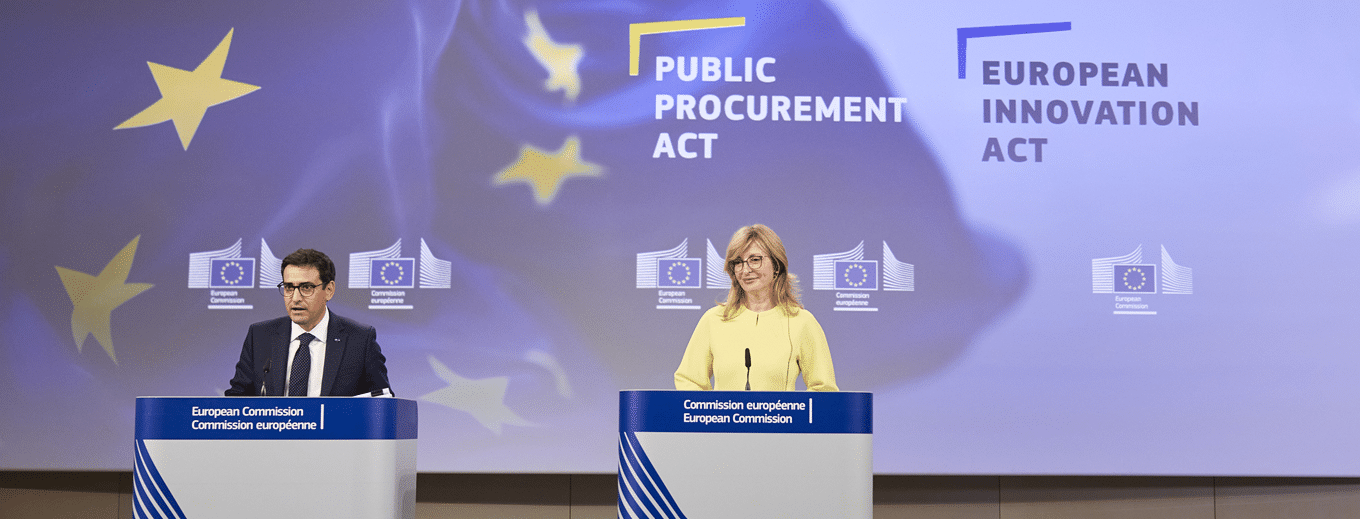
A central objective of the proposal is to turn public procurement into a stronger demand-side innovation policy instrument, which is why the proposal was published on the same day as the Public Procurement Act – an overhaul of the EU procurement rules. The Commission notes that public procurement of R&D remains fragmented and underused across Europe, despite its potential to stimulate the development and market uptake of innovative technologies. According to the proposal, the EU currently spends around 0.6% of total public procurement on R&D, compared with 3.5% in the United States and 5% in South Korea.
The proposed Regulation would establish harmonised rules for R&D procurement procedures across the EU, facilitate joint cross-border procurements and require public buyers to place greater emphasis on innovation-related criteria when awarding contracts. It would also introduce common provisions on risk-benefit sharing, intellectual property management and cross-border cooperation between public buyers.
A particularly important element is the introduction of an EU Preference regime for R&D procurement. Under Article 11, participation would generally be limited to operators established in EU Member States and in third countries covered by relevant international agreements granting access to the EU’s R&D procurement market – that is to say for EEA countries and the Western Balkans. The proposal further requires that at least 50% of the R&D activities carried out under a contract take place in eligible countries (EU, EEA, and Western Balkans). The proposal also allows public buyers to restrict participation to EU Member States only, in duly justified cases linked to security or public order concerns. Importantly, these provisions go beyond the general access framework of the EU Public Procurement Directives. While remaining subject to the EU’s international obligations, including World Trade Organization (WTO) commitments and applicable procurement agreements, the proposal explicitly allows public buyers to apply more restrictive access conditions in R&D procurement, including through additional localisation requirements for R&D activities.
The second pillar of the EIA concerns IP commercialisation. The Commission considers that a lack of harmonised valuation methodologies and limited use of IP as a financing asset continue to constrain European innovators’ access to capital. To address this issue, the proposal would extend the EUIPO’s mandate and establish a new Competence Centre on IP-backed Finance. The Centre would develop a voluntary EU framework for IP valuation, establish an EU-wide marketplace for licensing and transferring IP rights, support IP-backed financial instruments and provide advisory and capacity-building services for innovators and financial institutions. According to the proposal, the Competence Centre would support entities established in EU Member States only.
Alongside the EIA, the Commission proposed a separate Council Recommendation on regulatory sandboxes. Unlike the EIA Regulation, the Recommendation is non-binding and establishes a common EU reference framework for regulatory sandboxes, including common principles regarding their establishment, operation, transparency, regulatory learning and cross-border cooperation. Although it was initially intended to be included in the EIA, the Commission decided against it, notably because of the Regulatory Scrutiny Board’s negative opinion and to avoid “too narrow definitions and principles for regulatory sandboxes”.
While the proposal has just been put on the table, the legislative negotiations are also starting. Discussions in the Council began in the Research Working Party. A Partial General Approach is expected before the end of 2026, with the Council position likely to consolidate during early 2027. In parallel, the European Parliament is expected to appoint a rapporteur around October 2026 and adopt its position during the first half of 2027. Current indications point to an ambitious timetable, with co-legislators expected to adopt it by the end of 2027 and entry into force envisaged for January 2028. Based on these timelines, negotiations are expected to intensify significantly over the coming months, with particular attention to the implications of the EU Preference provisions for participation by entities from third countries, including Switzerland.