From a grassroots movement to an EU regulation: EU Inc. could reshape how companies start, scale, and operate seamlessly across the Single Market.
When the new College of Commissioners took office back in December 2024, the idea of a 28th Regime for EU companies had been floating around for a while – 28, as a reference to the EU 27 Member States and the addition of a 28th supranational layer. In April 2024, Enrico Letta revived this vision in his landmark report, which advocated for a unified Single Market and, more specifically, called for a new corporate regime that would allow businesses to operate seamlessly across Europe. This idea was then included in Ursula von der Leyen’s Political Guidelines 2024-2029 (published on 18 July 2024, which helped her to secure a second term at the helm of the European Commission), the mission letter for Commissioner Michael McGrath (EU Commissioner responsible for Democracy, Justice and the Rule of Law), the Competitiveness Compass (published in January 2025, and operationalising numerous recommendations from Letta and Draghi) and, lastly, the EU Startup and Scaleup Strategy (published in May 2025 and setting out a comprehensive roadmap including a set of actions to ‘make Europe to best place to start and scale businesses’).
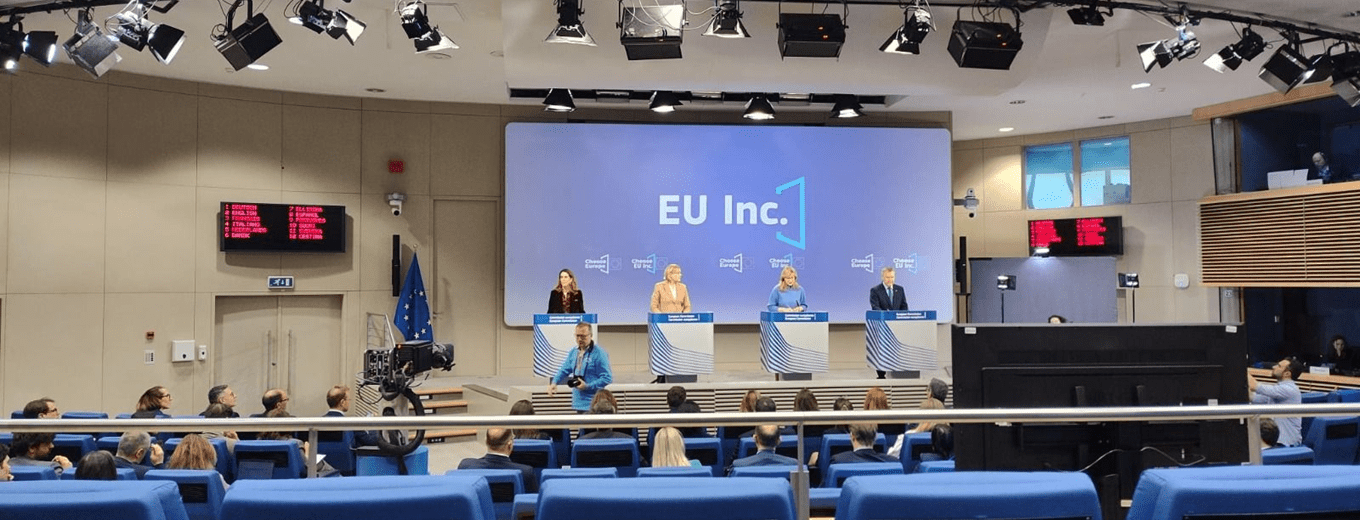
Yet, in parallel, a grassroots movement started to take shape in the background. Founders, investors and other players from the innovation ecosystem joined forces to launch the “EU-INC” movement. A petition was launched in late 2024 and rapidly gained 13’000+ signatories by December 2024. It is unclear when exactly the EU-INC originated, but as Andreas Klinger, one co-initiator of the initiative, puts it on a podcast, “EU-INC was built by founders, VCs, and ecosystem people who literally just got together in a WhatsApp group”. From this chat, a bottom-up movement was born that kept growing. The petition, which now has over 24’000 signatories, gained significant momentum in Brussels, and those ex-founders, turned investors, turned lobbyists, made their way into the EU policymaking process – being regularly invited to consultations and other meetings with EU officials. It is quite remarkable that their proposal, which was supported by experienced law firms to make it actionable within the EU institutions, really engaged senior representatives throughout the process, with four commissioners present at the press conference (see photo). The startup community is now recognised as essential for competitiveness rather than a nice-to-have. They were aiming for a bold proposal by the Commission: “Opting for a ‘Regulation’ will ensure standardisation and harmonisation for the corporate framework whereas opting for ‘Directive’ would likely result in fragmentation and uncertainty to applicable rules and legislation surrounding the EU-Inc, reducing entrepreneurs’ confidence and speed”. In EU law, a regulation obliges Member States directly to abide by it, while a directive asks Member States to implement it in national law.
The turning point of this campaign was undoubtedly when Ursula von der Leyen announced in her speech at the World Economic Forum on 21 January 2026 that the Commission now called “EU-Inc.” what was then known as the 28th Regime. The co-initiators from the startup community were, of course, very pleased to see their label being used by the European Commission’s president. However, they also knew the battle was not over yet.
Fast forward to 18 March 2026, the European Commission published its proposal: “[The] EU Inc. corporate legal framework provides faster (within 48 hours), cheaper (maximum EUR 100) and fully digital company registration […]. It also introduces fully digital insolvency procedures and automatic transmission of company data to relevant authorities in line with the ‘once-only principle’, while including safeguards against fraud and abuse. Moreover, it will provide a common optional scheme for employee stock options with harmonised deferred taxation, which will enable EU Inc. companies to attract the best talents.”
In a nutshell, EU Inc. is a “new harmonised legal form of a limited liability ‘EU Inc.’ company”, meaning that the company name will be followed by the label, i.e. “Name EU Inc.”. EU Inc. should be open to any legal entity that sees it fit for its purpose, without being specifically a startup or a scaleup. Although the EU Inc. does not restrict who can get it, the European Commission learned during the public consultation that this distinction between the definitions was recognised as an important one (e.g. to make eligibility requirements clearer for applicants). This also aligns with the existing EU definitions of SMEs and small mid-caps. Against this background, the European Commission issued, on the same day, a new recommendation defining “innovative enterprises”, “innovative startups”, and “innovative scaleups” to harmonise criteria across EU Member States and other institutions, such as the European Investment Bank (EIB) and the European Investment Fund (EIF). The factsheet accompanying the recommendation captures the different criteria well, and it will be interesting to see how these new criteria are applied to calls for proposals or instruments in the future.
Yet coming back to the EU Inc., although the Commission proposed it as a regulation (Art. 114 TFEU), it is not the same legal basis the startup community was advocating for (also a regulation, but based on Art. 352 TFEU). In fact, the chosen treaty article reduces divergences but still allows for national interpretation (or national provisions). However, it will not require the unanimity of all Member States to adopt it, but instead a qualified majority. The impact assessment also refers to the fact that too much harmonisation would not have been possible in a short time frame, which is another bold ambition of the Commission, given that they foresee an adoption by co-legislators by the end of 2026, and the first EU Inc. companies to be launched at the beginning of 2028. These divergences sparked some initial reactions from the startup community. They all commended the Commission for the joint work during the last year and saluted the proposal as “a necessary first step”. However, they also raised concerns that, without a truly uniform system, that includes a centralised court for dispute resolution and a single registration platform, EU Inc. risks remaining “European on paper, national in practice”. The upcoming trilogues will tell us more, but the EU is on its way, as Ursula von der Leyen stated, to “make it drastically easier to start and grow a business all across Europe”.