Swiss institutions explored how evolving European University Alliances can shape the local higher education landscape and foster innovation.
In the Brussels higher education ecosystem, the European University Initiative (EUI) continues to be a topic of lively discussion. Some alliances have already entered their second funding round, while others have only just begun their work. With the letter of intent accompanying European Commission (EC) President Ursula von der Leyen’s State of the European Union speech, the EC sent out a clear message by mentioning “Alliances 2.0”: European University Alliances are here to stay – and to further evolve.
To enable discussions among Swiss institutions already involved in, or considering participation in, alliances on how the initiative is developing in Switzerland, SwissCore co-organised and hosted a two-day symposium, “The Future of the European University Initiative”, with the Swiss Global Competence Lab (SGCL). The event was designed to provide space for reflection and peer exchange on how alliances shape the Swiss higher education landscape – and vice versa.
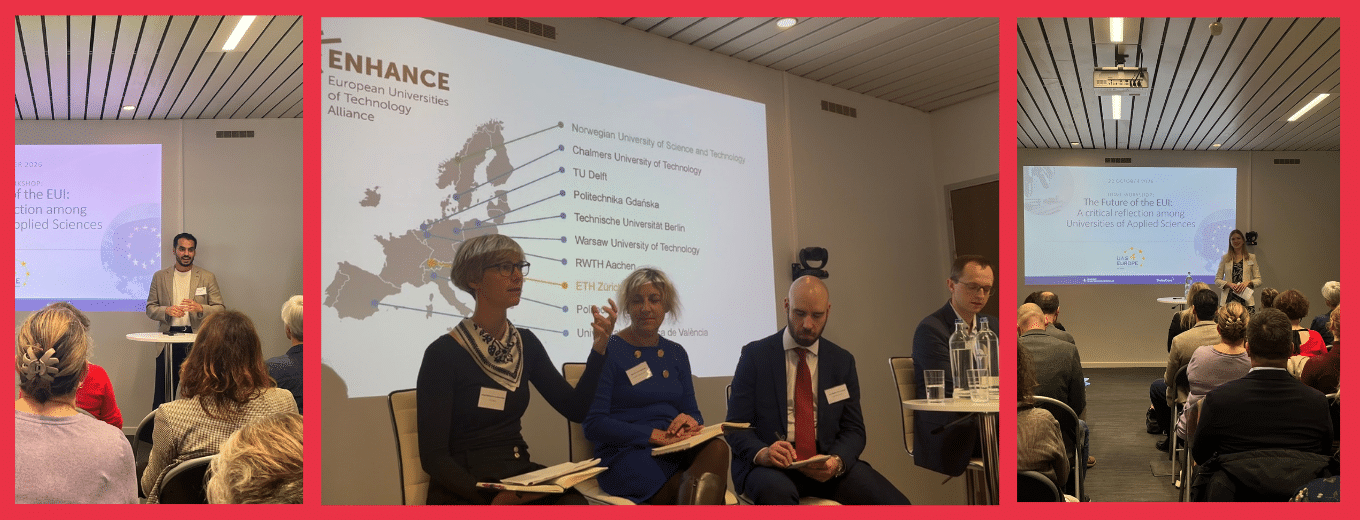
The programme opened with a workshop jointly organised with UAS4EUROPE, specifically targeting Universities of Applied Sciences (UAS). It aimed to explore the following question: “What determines whether the European University Initiative will be relevant, effective and successful for UAS in Europe in 2035?” Participants heard inputs from Mr Stefan Zotti, Deputy Head of Unit for Higher Education at DG EAC, and Ms Loredana Lombardi, Policy Officer in the Unit Education and Skills for Innovation, DG EAC. They then broke into smaller groups to consider whether current alliance governance models are fit for purpose for UAS and how alliances can align with the innovation- and skills-driven mission of UAS.
The discussions revealed that alliance governance could be further developed to provide sufficient flexibility to accommodate different institutional structures, capacities, and missions. At the same time, UAS are ideally positioned to contribute to the alliances’ focus on serving their ecosystems and delivering challenge-based education. Their continued involvement in the initiative was therefore deemed essential.
The remainder of the symposium provided a dedicated reflection space for Swiss institutions – both UAS and cantonal universities – through three thematic sessions. An academic keynote reviewed current literature on the state of play regarding alliances beyond the EUI as a relatively recent phenomenon in the European higher education landscape. A panel discussion among three alliance experts illustrated how alliances serve as platforms linking individual institutions to the wider European higher education agenda. This collaboration is particularly relevant for Swiss institutions, which confirmed that they find such engagement useful and necessary.
Lastly, a session on measuring the success of alliances showed broad consensus among Swiss Higher Education Institutions (HEIs) that some of the most valuable outcomes of alliances include strengthened European connections, new joint programmes, particularly Blended Intensive Programmes (BIPs), and pedagogical innovation.
SwissCore would like to thank the co-organisers, UAS4EUROPE and SGCL, all engaged speakers, as well as the symposium participants for their active and valuable contributions to this evolving debate.