
Global cooperation of a Swiss start-up transforms coral restoration and contributes to local expertise to regenerate threatened ecosystems.
Coral reefs play a crucial role in the marine ecosystem by providing a home for approximately 25% of all marine life. They sustain biodiversity, enhance food and economic security, and protect people living in coastal areas. Both people and marine species depend on coral reefs. However, today, a majority of coral reefs are under threat of disappearing due to climate change, pollution, and human activities such as overfishing. As a result, coral reefs are increasingly bleaching and dying, and it is estimated that 90% of the reef ecosystem might vanish by 2050 due to global warming. As they play an important role for the ocean and humans, it is essential to sustain and protect them.
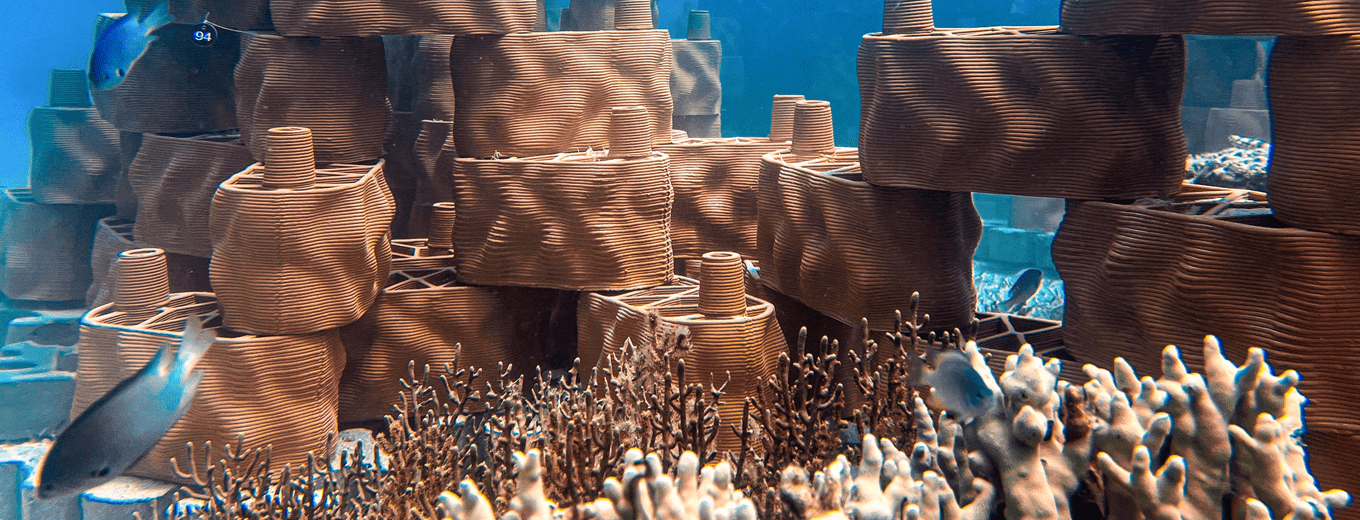
Global challenges like coral reef degradation transcend national boundaries and require shared knowledge, resources, long-term commitment and international cooperation. In this context, rrreefs, a start-up based in Switzerland, aims to protect coral reefs by scaling up regenerative actions. Co-founded in 2020 by four women, rrreefs stands for Rethinking, Rebuilding, and Regenerating coral reefs around the world. Dr. Ulrike Pfreundt, Marie Griesmar, Hanna Kuhfuss, and Josephine Graf, all from different backgrounds but connected through a shared passion for the ocean, came together to provide an interdisciplinary approach to the degradation of coral reefs. The start-up builds artificial reefs that act as substitutes to support the regeneration of coral reefs. The reef repair system is made of 3D-printed terracotta bricks. It consists of stacking the bricks on top of each other, thus creating a habitat for the marine ecosystem. Guided by ecological and engineering principles, these bricks are designed to enhance coral recruitment and foster a safe place for marine life.
The journey began as an ETH spin-off and has now grown into an independent organisation with its office in Zurich. In Germany, the organisation established an NGO that primarily covers developmental, scientific, and educational work pertaining to coral reef regeneration, working worldwide with a strong focus on the Philippines. R&D is an important driver for the future of its work. rrreefs follows a data-driven approach and conducts careful scientific monitoring to assess the impact of its projects in close partnership with local organisations and universities. The organisation believes in tailoring its reef systems to each environment, thus scientific knowledge, research, and monitoring are essential. This also makes close collaboration with locals a core aspect of its work, as local knowledge is crucial for sustaining corals. Therefore, beyond coral restoration, rrreefs is about knowledge and expertise transfer. It is about building a community that walks together towards coral regeneration.
The first project was implemented in 2021 in San Andrés Island, Colombia. A crowdfunding campaign was organised to help implement and initiate the project, and it provided an opportunity to have a workshop to disseminate knowledge and educate people about coral reef ecosystems. From then on, it kept growing, and currently, its projects are located in Ecuador, Colombia, the Maldives, and the Philippines. rrreefs has significant ties with the Latin American region. In 2023, the team was selected for the AIT Mexico 2nd Cycle 2022/23, provided by the Swiss Leading House for Latin America at the University of St.Gallen, in its mandate for the Swiss State Secretariat for Education, Research and Innovation (SERI). The AIT Mexico enabled opportunities to work on different projects across Latin America. Further on, the start-up broadened its scope beyond Latin America and engaged in collaborations globally, including tightening its ties with Switzerland. In fact, rrreefs had several occasions to be part of the Swissnex network, the Swiss global network for education, research and innovation, and partnered with them in events such as the New York Climate Week 2025.
In the broader international context, rrreefs’ project in the Philippines has been a significant milestone for the organisation. In collaboration with Davao Oriental State University, it established a local production facility, which further enhances the localisation of its work. As such, rrreefs works closely with universities, research institutions, governments, and local authorities to respond to its mission and vision – to regenerate coral ecosystems.
Overall, rrreefs places scientific knowledge, collaboration, and expertise transfer at the heart of coral restoration. A strong emphasis is placed on training locals so that they can conduct the projects independently in the long run, which enhances long-term sustainability and resilience of the projects. As for future endeavours, rrreefs aims to further extend its expertise and partnerships to different regions, including Europe, especially via Horizon Europe funding. The hope is to build more connections to raise greater awareness on coral reef regeneration.
As rrreefs seeks funding and partners to grow its science‑driven restoration work, strengthened Swiss–EU cooperation under Horizon Europe offers an ideal framework, complemented by the expertise of its German and international counterparts.
For a greater glimpse into rrreefs’ story, have a look at its documentary.