
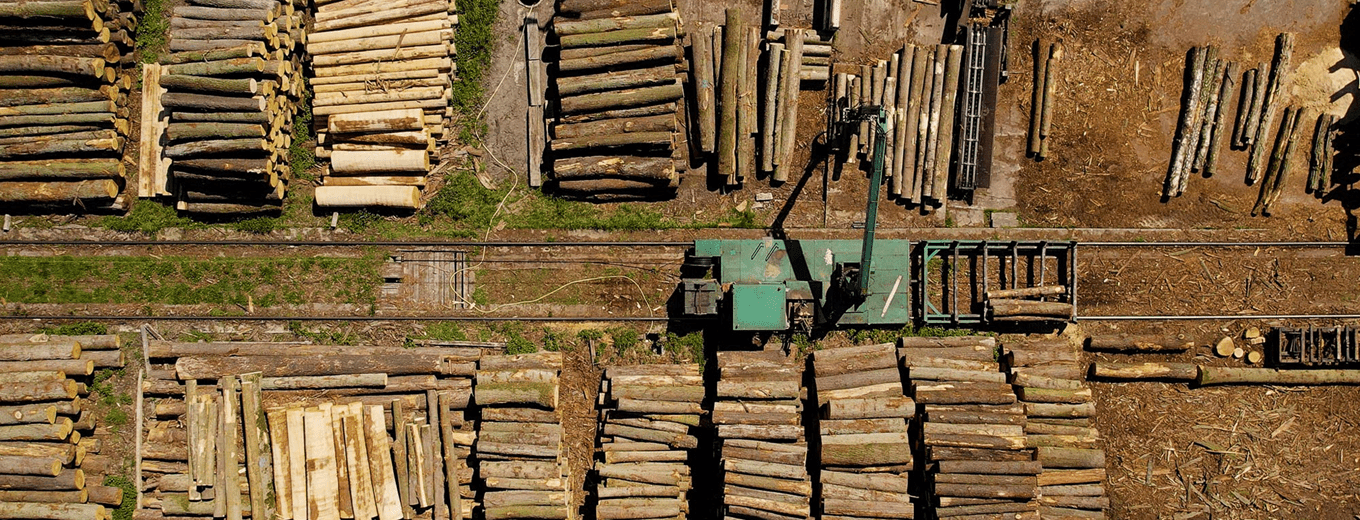
Empa is using AI to unlock Europe’s underused hardwoods, helping the EU project TIMBERHAUS build a more diverse, resilient timber industry.
There is a mismatch at the heart of the European wood construction value chain. About half of Europe’s forests are hardwood, but less than 5% of commercial wood construction products are.[1] The value chain is built around only a few softwood species. That makes it highly vulnerable to anything that puts them under pressure. Wood, with its carbon-storing properties, is one of the most promising substitutes for carbon-intensive materials like steel and concrete, so demand is set to grow. At the same time, climate change is reshaping Europe’s forests and with them the raw material that will actually be available. Securing a sustainable and resilient timber supply is therefore becoming just as urgent as using more wood in the first place.
Launched in Copenhagen in November 2024, TIMBERHAUS is a four-year project co-funded by the EU’s Horizon Europe programme and the Swiss State Secretariat for Education, Research and Innovation (SERI), bringing together 19 partners from ten countries, including the Swiss Federal Laboratories for Materials Science and Technology (Empa) and ETH Zurich from Switzerland. Its goal is to change how timber is used in construction. Coordinated by the Danish Technological Institute, the project unites researchers, technology developers, manufacturers, designers and city administrations around a shared goal: making wider, smarter use of Europe’s underused hardwoods and post-consumer recycled wood. The three partner cities of Berlin, Baia Mare (Romania) and Siena (Italy) will co-create and pilot the resulting building blueprints with local stakeholders, ensuring the solutions fit local needs, traditions and design languages.
Wood is not a single, uniform material. Its properties vary considerably between species, but also within individual trees, depending on growth conditions, age and natural characteristics such as knots or grain structure. Norway spruce has become the dominant construction species in Europe because it is widely available, easy to process, well characterised and supported by established grading and manufacturing systems. As a result, the entire value chain, from forestry and sawmilling to engineered wood production and construction, has been adapted around this species.
The challenge, explains Mark Schubert, head of the WoodTec group at Empa, is that future forests are expected to provide a more diverse mix of species and wood qualities. As heat, drought and other climate-related stresses affect forest ecosystems, the variability of timber resources is increasing. Supply chains designed around a small number of well-established species are not necessarily equipped to make efficient use of this broader resource base.
For Empa, the answer is not to run from this complexity but to deal with it. Empa researchers are developing AI-based methods to characterise timber properties such as species, quality, dimensional stability, bonding performance and the occurrence of defects. This information is then used to design engineered hybrid wood products and construction systems, from load-bearing elements for multi-storey buildings to flooring solutions that combine hardwood and post-consumer wood. As Schubert puts it, the sector needs a “paradigm shift”: rather than continuing to reduce complexity by relying on a single, simple species, the industry needs tools that let it work productively with a much wider, more efficient range of wood.
This work started at Technology Readiness Level (TRL) 3 and aims to reach TRL 6, a technology demonstrated in a relevant environment, by the project’s end in 2028. Beyond the qualities of the wood itself, complexity in the sector is also shaped by policy, standards and market structures. No single institution covers that range, which is where the consortium comes in: architectural practices such as Waugh Thistleton Architects translate the material into building concepts, industrial partners such as Junckers, Pfeifer and Grupo Gámiz bring manufacturing capacity, and the three partner cities test the results against real planning and procurement conditions.
As one of two Swiss partners in a 19-strong, EU-wide consortium, Empa has also gained first-hand experience of what it means to collaborate on a jointly EU–Switzerland co-funded project. TIMBERHAUS goes back to a 2024 call, when Switzerland was still a non-associated third country, which is why the Swiss partners are funded directly by SERI. The EU Programmes Agreement signed on 10 November 2025 associated Switzerland to Horizon Europe retroactively from 1 January 2025 and applies to projects from the 2025 calls onwards. For TIMBERHAUS itself, Schubert notes, little changed in practical terms. What did change is the outlook: working from within an associated country makes participation in projects of this kind more predictable, and removes the uncertainty that came with project-by-project arrangements. With two years still to run, TIMBERHAUS is only one step in a longer trajectory for Empa’s wood research. Post-consumer wood is already one of the two underused resources at the centre of the project, and the group is looking at how these AI-driven approaches to wood complexity can be transferred to industry and applied to a wider range of recovered material. That extends the ambition of a more diverse, resilient and circular European timber sector well beyond 2028. Through the co-creation work with Berlin, Baia Mare and Siena, TIMBERHAUS also connects to the goals of the New European Bauhaus, contributing to a vision of construction that is locally rooted, design conscious and more circular.