
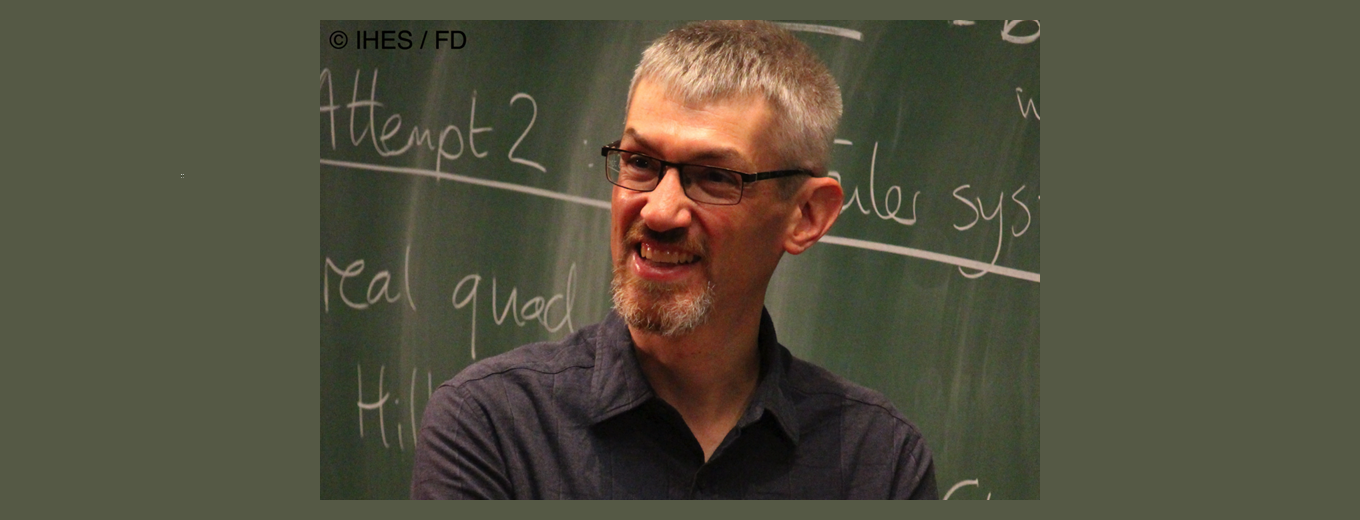
Prof. Dr. David Loeffler’s ERC grant strengthens Swiss–EU research ties and advances number theory, highlighting cross-border scientific collaboration.
UniDistance Suisse (FernUni Schweiz) is a Swiss accredited university institute for distance university education and research. Since 1992, it has offered flexible and high-quality study programmes that allow students to pursue a university degree alongside professional, family, sports or cultural commitments. Today, the institution teaches around 2’600 students in German, French and English and employs more than 500 staff, including over 400 researchers and lecturers. With innovative digital methods and a strong focus on socially relevant topics, UniDistance Suisse plays a key role in expanding access to higher education.
As a multilingual and intercultural institution, UniDistance Suisse places international cooperation at the heart of its mission. It maintains active partnerships with universities abroad and is a member of several international networks such as the European Association of Distance Teaching Universities (EADTU), the International Council for Open and Distance Education (ICDE) and Digital Learning Europe (EDEN). These connections allow the institution and its researchers to collaborate closely with partners around in Europe and globally. Supporting international research proposals is a central priority. The university institute is also a recognised actor in international research on online learning, contributing expertise to projects that examine digital teaching, learning environments and the future of distance education among others through its Educational Development Unit in Distance Learning (EDUDL+).
ERC excellence in number theory: Prof. David Loeffler and Swiss–EU collaboration
Prof. Dr. David Loeffler, Professor of Mathematics at UniDistance Suisse, is one of Europe’s leading experts in number theory, the field studying fundamental questions about whole numbers, equations and the deeper structures that govern them. He leads the ERC-funded research project “Shimura varieties and the BSD conjecture” a Consolidator Grant running from 2021 to 2026.
Prof. Dr. David Loeffler’s project focuses on one of the most famous unsolved problems in mathematics, the Birch and Swinnerton-Dyer (BSD) conjecture, a Millennium Prize Problem concerning rational solutions of elliptic curves. Despite major progress in the 1990s, key aspects remain open, and the project seeks to prove new cases using innovative methods. Loeffler’s group has already made notable advances, including showing that an Euler system, originally sought by Andrew Wiles during his work on Fermat’s Last Theorem, does in fact exist, a breakthrough achieved using techniques developed through the ERC grant. This result underscores how the project is pushing research at the very frontier of modern number theory.
The ERC Consolidator Grant is one of Europe’s most competitive funding instruments for mid-career researchers. UniDistance Suisse proved to be an ideal host institution for such a cross-border project. Its strong experience in online collaboration, combined with modern research infrastructure in Brig, creates a setting that supports a geographically distributed team. As the institution notes, its distance-education model means it already has both the equipment and expertise to support research collaboration at a distance. Hosting an ERC project not only advances mathematical research but also increases the international visibility of UniDistance Suisse. The ERC grant further supports UniDistance Suisse’s growth as a young university institute that aims to become a cantonal university in 2027 with the strong support of the Canton of Valais.
Looking ahead
Long-term perspectives for the ERC grant are equally promising. Loeffler’s project has already led to major breakthroughs in number theory as mentioned above, and a range of follow-up projects are planned to strengthen the position of his research group at UniDistance Suisse among Europe’s leading centres in the field. This example illustrates why Swiss participation in EU research framework programmes is essential. Collaboration benefits both sides: it enables Switzerland to strengthen its scientific excellence while giving European partners access to Swiss expertise, infrastructure and innovative approaches. By fostering such partnerships, Swiss and EU researchers together can tackle frontier challenges, advance knowledge and build networks that drive science forward across Europe.