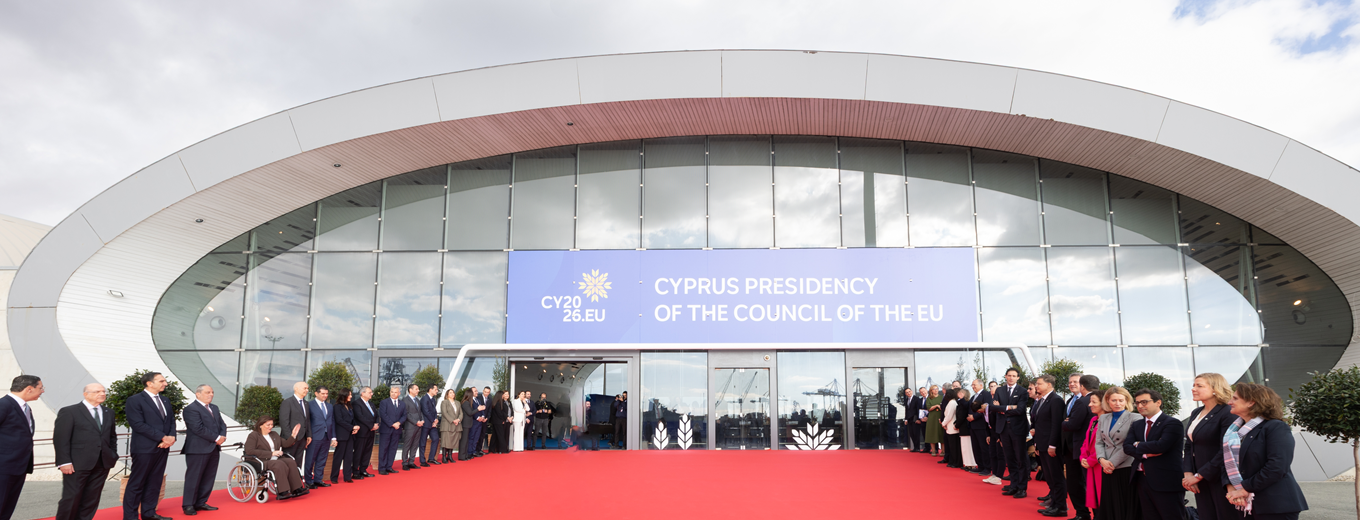
With the beginning of a new year, a new EU country takes the helm of the Council of the EU. The Cypriot government starts their presidency in turbulent times.
On 1 January 2026, Cyprus will take on the Presidency of the Council of the EU, following Denmark and preceding Ireland. The Cypriot Presidency chose the motto “An autonomous Union. Open to the World”, addressing the challenge to balance international cooperation while maintaining and increasing the ability to act independently. This theme is present in the EU debate for a while already, also called ‘open strategic autonomy’ or ‘derisking, not decoupling’ by senior EU leaders. The current geopolitically turbulent times with unreliable partners in many parts of the world, accentuated this tension between openness and protectionism further. The Cypriot Presidency will pursue five overarching priorities: i. Autonomy through security, defence readiness and preparedness, ii. Autonomy through competitiveness, iii. Open to the world, autonomous, iv. An autonomous Union of values that leaves no one behind, v. A long-term budget for an autonomous Union. So in a sense, there is little novelty but a clear focus.
In the field of research and innovation, the Cypriot Presidency wants to foster a balanced European research and innovation landscape, striving to boost excellence and bridge the persistent innovation gap between Member States – this links to the Widening debate as Cyprus is a widening category country itself. A key focus will be set on furthering deeper single market integration. The Presidency also intends to advocate for robust R&I funding for FP10 in the upcoming negotiations of the multiannual financial framework (MFF, 2028-2034), ensuring support across all technology readiness levels (TRL), while pushing forward the ongoing debate around the European Innovation Act. Recognising the important role of smaller enterprises in Europe’s innovation ecosystem, there will be a special focus on enhancing conditions for SMEs and startups. In addition, the Presidency seeks to advance science diplomacy and promote international partnerships in research and innovation, reinforcing the development of open innovation ecosystems across the continent. Geographically, they want to put a focus on the Mediterranean and the Gulf region, given Cyprus’s location.
In the field of education, the Cypriot Presidency is committed to progressing the negotiations for the next phase of Erasmus+ (2028–2034). The agenda will place a strong focus on a holistic, learner-centred approach to skills development, prioritising inclusion, lifelong learning and the development of both digital and green competences. Further discussions will be held on the Teachers’ Agenda, particularly focusing on making teaching careers more attractive and empowering educators; this topic is on the agenda of the education ministers as well including with Swiss representation at the meeting. The Presidency also intends to boost the appeal of vocational education and training (VET), integrating new technologies to make sure VET stays relevant. In higher education, particular attention will be given to enhancing mobility and internationalisation, alongside the ongoing work towards establishing a European Degree.
Finally, as we head into 2026, Switzerland is now officially also associated to and participating in ITER, the international fusion experimental reactor. This is following the signature of the EU-Swiss agreement of programme participation last autumn, which also enabled Swiss association to Horizon Europe, Digital Europe Programme and Euratom from 1 January 2025. A full association to Erasmus+ is expected for 2027.