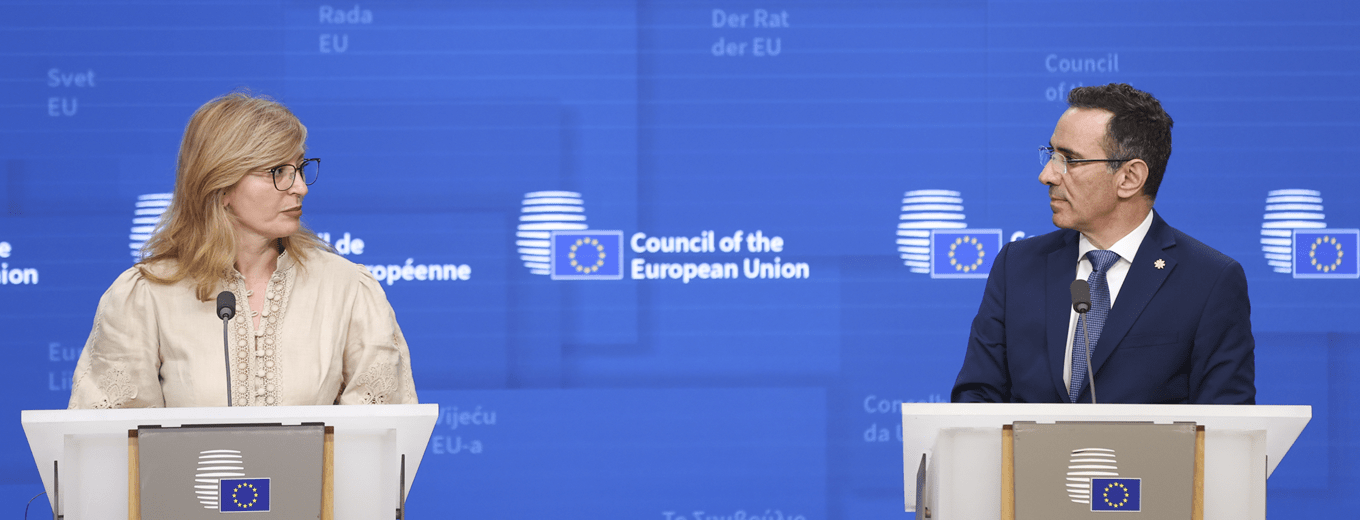
“The current geopolitical context […] reinforces the need for strengthened cooperation with like-minded partners such as Switzerland.”
The Council of the EU (Member States) adopted Council Conclusions on EU relations with non-EU Western European countries, among them Switzerland, on 16 June 2026. While the Council is very positive on the relations with Switzerland and “welcomes the renewed engagement between the EU and Switzerland”, some paragraphs give signals regarding its future. Paragraph 81 states that “Switzerland is a close and longstanding partner […] and one of the most closely associated Western European partners of the EU after the EEA EFTA States”; and further: “The current geopolitical context […] reinforces the need for strengthened cooperation with like-minded partners such as Switzerland”. On education, research and innovation, paragraph 90 underlines the importances of the Agreement on Switzerland’s participation in the research, innovation and digital programmes. On education specifically, “the Council expects Switzerland’s association to Erasmus+ as of 1 January 2027 as both sides committed to in the Agreement”. This is relevant as the Swiss Parliament will vote on the Swiss contribution to Erasmus+ in the second half of this year. Finally, the text also talks about the whole set of new agreements that Switzerland and the EU concluded: Paragraph 93 makes it very clear that “the agreements were negotiated as a package that is carefully balanced to reflect the mutual interests”. And, further on, the paragraph becomes very explicit and clear: “The package of agreements constitutes a coherent whole, whose integrity needs to be preserved”.
A bit later in June, on 26 June, the Council also agreed on its position, the so-called Partial General Approach (PGA), on FP10. Its main divergence from the Commission proposal are about strengthening the role of Member States in the governance of the research and innovation framework programme and introducing stronger language on research security. Regarding the collaboration with Switzerland and other associated countries, the Council introduced new language calling to “actively and more strategically deepen collaboration with trusted like-minded countries to the benefit of both parties”. Linked to FP10, the Council has this month also agreed on their common position on the European Competitiveness Fund (ECF). In its compromise text the Council proposes a stronger role for the Member State in a new ECF General Committee that would advise or guide the fund, including also FP10. And finally, the Council also upholds in both PGAs the strong connection between FP10 and ECF through integrated work programmes and joint priority setting under FP10’s Pillar 2 for Competitiveness research. Both these Council positions are the basis for the upcoming intern-institutional negotiations with the European Parliament and the Commission.
The Swiss State Secretariat for Education, Research and Innovation (SERI) published a study on the impact of Swiss participation in Horizon 2020. The study is based on interviews with successful and unsuccessful Swiss actors who have applied for European funding. The findings clearly show that the participation in Horizon 2020 leads to an increase in the competitiveness of the national research and innovation system. The participation enables access to critical infrastructure, test environments and specialist knowhow for Swiss-based researchers and companies. Finally, collaborating via Horizon 2020 enables building long-term networks and market access, which is particularly relevant for Swiss start-ups. The study also found that the stable and uninterrupted participation in the programme is decisive to create this measured impact.
In other news, another new country is joining the Horizon Europe fold: On 9 June 2026, Australia and the EU successfully conclude the association agreement negotiations. We therefore expect Australia and Japan to be fully associated to Pillar 2 soon, with transitional arrangements already in place.