The Swiss government, the Federal Council, adopted a package of new agreements with the EU to stabilise and further develop the Swiss-EU relations.
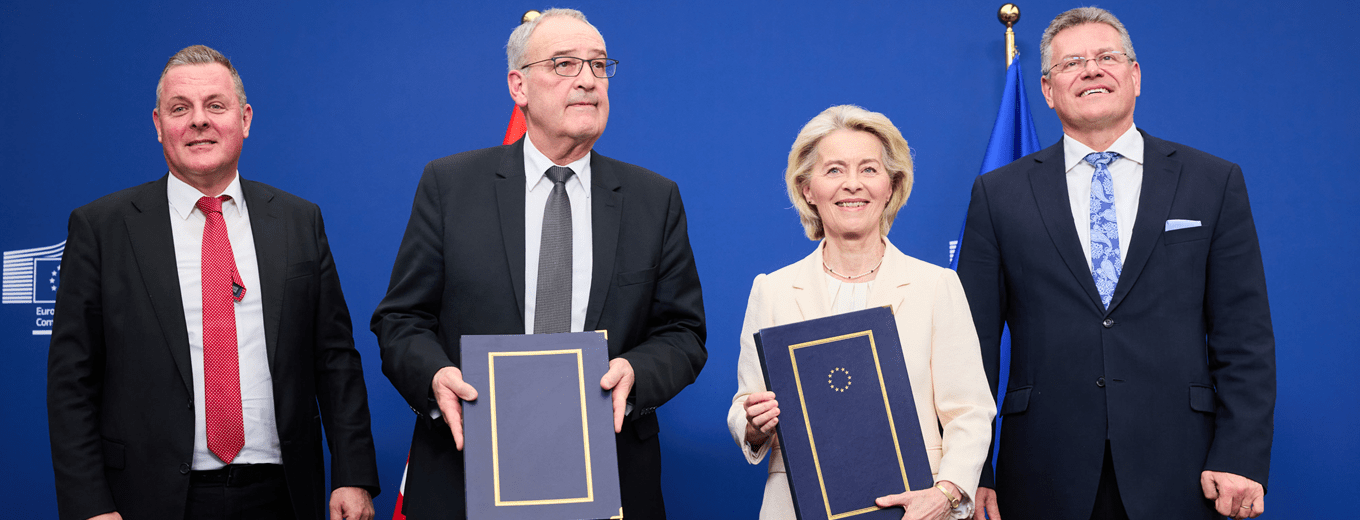
Yet another strong step forward in the Swiss-EU relationship: On 13 March 2026, the Swiss government (the Federal Council) adopted the package of agreements between Switzerland and the EU, often nicknamed ‘Bilaterals III’. The official name of the dispatch is ‘stabilisation and further development of Swiss-EU relations’, including agreements and changes to agreements on free movement of persons, protection of salaries, transport, electricity, health, food safety and programme participation. The new agreement on programme participation was already signed exceptionally earlier on 10 November 2025 (see SwissCore article) so that a participation in Horizon Europe and related programmes could start immediately. In their communication on the adoption, the Federal Council stated that “in view of the tense geopolitical situation, stable and reliable relations with neighbouring European countries are of strategic importance.” The package of agreements and proposed changes to national laws will now be debated in the Swiss Parliament and then ultimately subjected to a popular vote in a referendum in the coming years. So as you can read, it is by far not the end of this political marathon process, but nevertheless all steps forward have been very positive from the Swiss and the EU sides.
On the very same day, 13 March 2026, the European Parliament (EP) rapporteur for the next framework programme for research and innovation (FP10) published their draft report on the Commission’s proposal for FP10. The report and its proposed amendments are the basis for the EP’s position for the trilogue negotiations with Commission and Council planned for the end of this or beginning of next year. The Parliament rapporteur’s position is more ambitious and picks up certain interests of the research and innovation stakeholders, such as for example a higher budget (€220 billion) or moving towards a more bottom-up programme steered by experts instead of Commission officials. The rapporteur also advocates strongly for a strengthening of the ERC and EIC autonomy. Finally, the report proposes to separate the committees and the programming between FP10 and the European Competitiveness Fund (ECF), while stipulating regular joint coordination between the different committees. When it comes to Switzerland and association of non-EU countries, the report is more cautious. The report maintains the country categories for association detailed in article 9. The amendments do not make the collaboration between associated third-countries and the programme easier or more predictable. However, the rapporteur mentions in his explanatory statement to the amendments that the EU must “be transparent to remain trustworthy partners”; and therefore that “security-based restrictions on participation be subject to a decision-making framework. This framework should be adopted as a Delegated Act. It should also include our approach to association agreements and the scope of these associations”. This delegated act should specify how Article 10 on EU Preference from ECF will apply to FP10, based on the following assessment criteria how the restrictions impact: i. the EU’s scientific position in the world, ii. the EU’s global competitiveness, iii. the EU’s resilience and strategic autonomy, iv. the EU’s security, and the balance of all these considerations. Whether such a delegated act would bring more stability and predictability into international cooperation with Horizon Europe / FP10 remains to be seen.
The European Parliament proposal for the next Erasmus+ programme is expected to be published in May 2026. Thereafter, the MEPs responsible for science and for education respectively will consolidate the Parliament’s positions and adopt the final reports in September 2026 for FP10 and Erasmus+.