
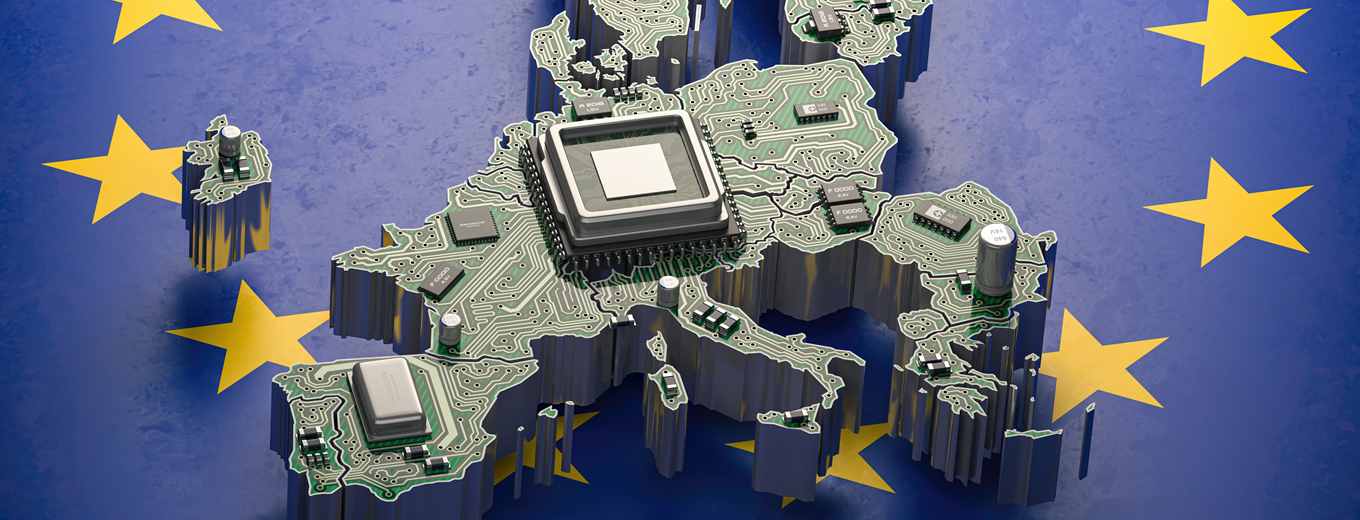
Several European university associations propose amendments for FP10 to simplify association and collaboration with UK and Switzerland.
Senior colleagues from the European Commission shared their vision for the future of the EU’s industrial policy in a recent reflection paper from 11 December 2025. The paper entitled ‘How Europe could get both, the Green and the Deal’ is co-authored by civil servants from the Commission’s Directorate-General for Internal Market, Industry, Entrepreneurship and SMEs (DG GROW), notably Deputy Director-General Maive Rute and Frank Vandermeeren from the Chief Economist team. The paper does therefore not officially represent the view from the Commission but gives nevertheless an interesting insight into the thinking of the EU’s industrial policy.
The premise of the paper is that the political and economic context that the EU operates in has fundamentally changed over the past ten years, and that therefore another industrial approach is necessary. The main elements identified for this changing context are the appearance of new digital technologies, the “restricting of global value chains”, “aggressive industrial expansion” in some non-EU countries, and finally increasing security risks. As the main axes of action, or rather reaction, the authors focus on investment and innovation, securing supply and value chains and scaling up defence capabilities. So far, this analysis of the challenges Europe faces and has to address bears little surprises and is shared by many. However, the consequential concrete suggestions could be more controversial. In brief, the paper calls for a more centralised and directional industrial policy.
According to the paper, today’s EU approach is “largely non-directional and decentralised”; in other words, the EU fosters competition and free markets, and importantly, does not intervene in specific industry sectors. The authors are convinced that in today’s global economy, the level playing field for free-market competition is no longer given and will ultimately loose out against what they call “winner-takes-all dynamics”. In order to react to this changing context, the DG GROW authors ask for a recalibration: While the EU should continue the long-term priority-setting and ensure the well-functioning of the Single Market, it should also introduce sector-specific interventionist industrial policies. The idea is to back high-risk, high-reward technologies “through mission-oriented approaches”.
This idea then touches upon research and innovation policies and programmes. The paper calls for a stronger focus on innovation, as the current policies “struggle to bring innovations into markets”. The authors maintain that “fundamental research remains essential” but “Europe’s research excellence has sometimes been the seedbed for industrial value created elsewhere”, therefore EU needs to “better protect and capture that downstream value through deliberate, coordinated action”. Concretely, they suggest that FP10 should have dedicated ring-fenced budgets to strategic missions and ensure risky breakthroughs. Furthermore, they also advocate for dual use innovation support.
Whether this is a necessary shift and further protection is really the right way to go in the long-run remains to be seen. The Swiss experience shows that a strong focus on bottom-up, liberal policies paired with creating attractive and coherent conditions for a strong research, innovation and education system is the key to success.
Meanwhile, the negotiations and advocacy for FP10 are continuing. On 1 December 2025, a strong group of university stakeholder associations in Brussels published their key proposals and a detailed list of amendments to the FP10 legal text. The amendments are drafted and presented by CESAER, Coimbra Group, EUA, EU-LIFE, The Guild, LERU and YERUN. While the proposed amendments concern various articles of the draft FP10 regulation over 114 pages, a few concrete points bear strong relevance to international cooperation and Switzerland in particular. The associations propose to amend Article 9 (1) that sets out the categories for association to the framework programme. In their amendments, they propose to create a separate category (new category d) that would only include the UK and Switzerland (the current category d would become e). The rationale behind the proposal is that there are “long-standing ties of scientific and institutional cooperation between the EU, the UK and Switzerland” that have “consistently demonstrated mutual benefit, high scientific performance and alignment with the objectives and values of the Union” (page 46). Based on this new category, they propose to introduce a new article 9 (6a) that stipulates “simplified and expedited procedure for renewing their association” while also “minimising administrative disruption to ongoing and future collaborations”. Furthermore, they also propose reverting to the current eligibility rules in Article 21 (3) requiring only at least one legal entity from an EU Member State and at least two legal entities in different EU Member States or associated countries. The European Commission proposes to require at least two entities from EU Member States and only one from another EU Member State or associated country.
And finally, to conclude this year with some good news: The UK and the EU have concluded their negotiations and found agreement on a UK re-association to the Erasmus+ programme, starting in 2027. The UK might therefore find its place back in the Erasmus fold at the same time as Switzerland.