
UAS4EUROPE held its biennial Networking Conference in Brussels and demonstrated the added-value of Universities of Applied Sciences for European innovation.
UAS4EUROPE is an informal network founded in 2016 that represents over 150 Universities of Applied Sciences (UAS) in the European Research Area (ERA). It counts eight full members – all umbrella associations or rectors’ conferences – in six different countries: Austria, Denmark, Finland, Germany, the Netherlands, and Switzerland.
Every two years, UAS4EUROPE organises its Networking Conference to gather participants from UAS across Europe, policymakers and other stakeholders from the research and innovation community. This year’s edition brought together over 100 participants and focused on how to unite Innovation & Skills, two topics of critical importance for the UAS’ mission. Indeed, UAS train a highly skilled workforce but also push students and researchers to bring knowledge to concrete applications through strong ties with local industry partners, public organisations, and civil society. Furthermore, with the EU Innovation Act set to be proposed in the first quarter of 2026, the event provided an opportunity to discuss the results of the public consultation, what the Act will entail, and what it aims to achieve.
This article focuses on the Swiss participation in the UAS4EUROPE conference and, more broadly, in the network. SwissCore, as liaison office in Brussels, takes an active role and represents the Chamber of universities of applied sciences and arts – an official body of swissuniversities, the Swiss rectors’ conference, which is a founding member of UAS4EUROPE. The Swiss UAS Chamber is officially represented in the network by Prof. Dr. Crispino Bergamaschi, President of the University of Applied Sciences and Arts Northwestern Switzerland (FHNW).
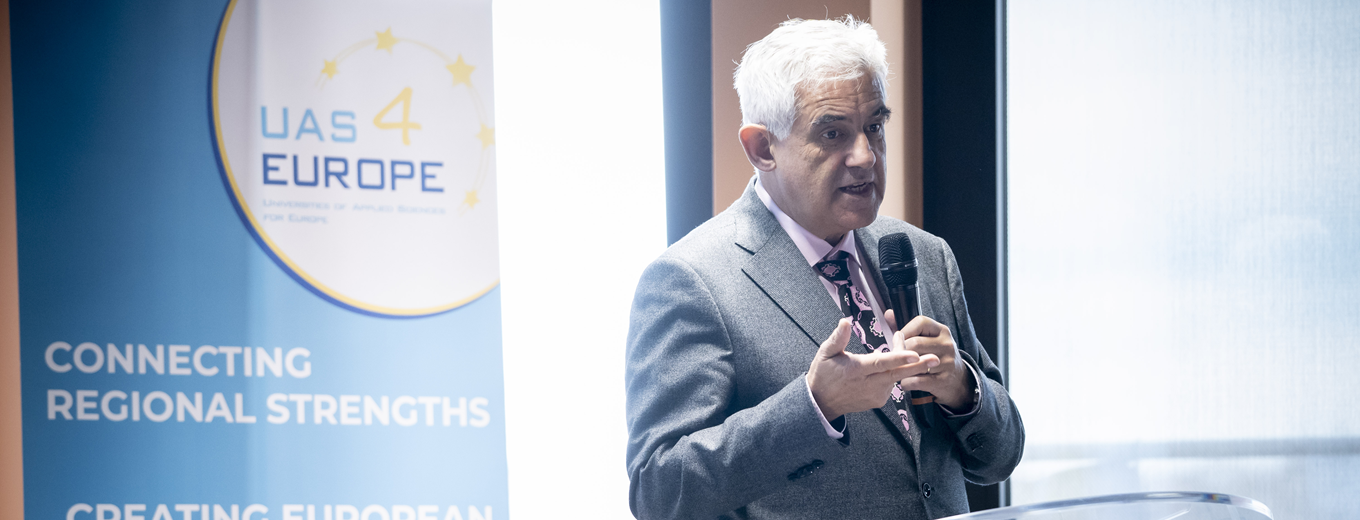
During the Networking Conference, Prof. Dr. Bergamaschi delivered an introductory keynote on the UAS Impact on Regional Innovation Ecosystems, providing concrete examples from the Swiss UAS ecosystem. His participation in the event in Brussels was particularly timely, as Federal Councillor Guy Parmelin and European Commissioner Ekaterina Zaharieva signed the Switzerland-EU programme agreement two days before the conference – formalising the association to programmes, such as Horizon Europe, Digital Europe and Erasmus+ (from 2027).
Coming back to the conference, Prof. Dr. Bergamaschi started by elaborating on the various ingredients needed for general welfare, as well as the characteristics of innovation. On the one hand, welfare depends on the economic prosperity of regional companies, which create jobs and generate taxes – all of which feed back into the local economy. On the other hand, innovation builds on several success factors, such as time-to-market, out-of-the-box thinking, customer focus, and highly skilled and motivated employees. A blend of all these ingredients enables an ecosystem to build general welfare through growth and prosperity.
Prof. Dr. Bergamaschi continued by presenting some key features of the Swiss UAS model: (i) students join UAS to follow full- or part-time studies (the latter allowing to gain professional experience in a relevant environment while studying applicable theoretical practices); (ii) UAS professors have various career tracks, including academic and industry practice-oriented roles. They can teach either full-time or part-time, which allows them to pursue additional professional commitments; (iii) UAS offer continuous education to more experienced staff, which turns out to be an excellent business model for UAS to attract third-party funding. This requires good connections with the private and public sectors to establish the trust and ensure employees benefit from such programmes and transfer the knowledge back into their organisations; and (iv) UAS perform applied research for and with the industry, but also for the public sector and the broader civil society: projects are supported either through grants from public funders such as Horizon Europe, or directly through the industrial partners themselves remunerating the UAS for their applied research services – the latter being again another great source of third-party funding for the institution. Given that some facts and figures about FHNW’s business model sparked interest in the room, more information is available on their website.
The keynote reasserted the strong role of UAS in their regional ecosystems, and Prof. Dr. Bergamaschi, in a slightly provocative manner, expressed that for all reasons mentioned above, UAS embody the universities’ third mission for their contribution to society, therefore not needing to create a theoretical third mission (complementing teaching and research, the first and second missions respectively). He also conveyed a final main message, underlining that in order “to create a sound functioning innovation ecosystem, UAS need to work with the industry on eye level”. That spirit carried the audience through the remainder of the conference, offering key insights into the Swiss ecosystem and reflections on the role of UAS in the ERA.